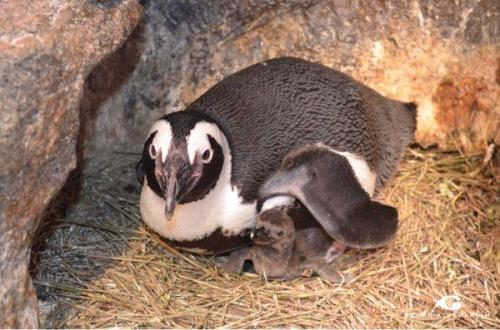
November 5, 2009

Penguin <3's Zookeeper

From ABCNews, an interesting and a bit humorous article about how a penguin got hard feelings for her zookeeper.


Picky Penguin Has Love Affair with Zookeeper

Love is Lost and Found Again Between a Picky Penguin and Her Devoted Zookeeper

“Old love never dies,” the country song goes, “it just fades away.” Well, maybe so, but occasionally it comes back, too. At least that’s the case when it comes to an animal keeper in the southern German city of Münster and a penguin named Sandy.

Picky Penguin Gets Her Man Back


Thirteen years ago, the African penguin Sandy arrived in Münster’s zoo. She ignored all the other penguins and only paid attention to her keeper, Peter Vollbracht. “I didn’t choose her,” says Vollbracht. “She chose me. I was just her big penguin.”
This roller-coaster story of love started 13 years ago, when a one-year-old African penguin was transferred from a zoo in Nuremberg to the Allwetterzoo Münster. But rather than integrating herself into the penguin population, Sandy set her sights on her keeper. “At the beginning,” Peter Vollbracht, 47, told SPIEGEL ONLINE, “we found it very funny. Normally you have to wear thick gloves to handle these penguins because they have really sharp beaks and can give you a good whack with their wings. But Sandy” — as Vollbracht named her — “would just sit on my boot or arm and ask to be petted.”

Still, at a certain point, friendliness turned a bit into obsession. “There was nothing we could do about it,” Vollbracht says. “I didn’t choose her; she chose me. When I would get to work in the morning, she would be there waiting for me and call out to me. And when we did our daily penguin march for exercise, she would always jump to the front of the line to be next to me.”

With Vollbracht around, Sandy completely ignored the zoo’s other 80-plus penguins. “She didn’t care about anyone else,” Vollbracht says. “I was just her big penguin.” The atypical relationship was good for the zoo. Although most penguins shun human contact, Sandy let Vollbracht and others pet her. In addition to visiting schools, handicapped children and retirement homes, Sandy and Vollbracht made the rounds of Germany’s leading talk and late-night entertainment shows. Sandy also landed a couple of parts in German films on her way to joining the top-tier of beloved animals — like Berlin’s celebrity polar bear, Knut — in this animal-obsessed country.

But then everything changed.

During the filming of a movie with Sandy in 2006, Vollbracht got sick and had to stay home from work for six weeks. But when he finally returned to the zoo, Sandy had found someone else. “If their partner is gone for a few weeks,” Vollbracht says of these primarily monogamous birds, “they go back out on a partner hunt.” “After 10 years of having her on my arm,” Vollbracht says with a wistful sigh, “she’d completely written me off.” Sandy was now with Tom, a much younger penguin. “At the beginning,” Vollbracht says, “it was weird. But, when all’s said and done, it was better for her to lead a normal penguin life.” And that’s exactly what she did. In 2008, after a few mating seasons of near misses, Tom and Sandy eventually started a family of their own with two chicks. But this September, Tom died of a bacterial infection. Since raising two chicks was “too much for her to handle on her own,” they were placed in a foster nest. And Sandy was single again.

“After Tom died,” Vollbracht says, “I came back to work from vacation, and it was like she’d flipped a switch. She was looking for someone, and I was there.”
Now Sandy and Vollbracht are back together again and pleasing the crowds with their daily shows of affection. For Vollbracht, who has a wife and two children of his own to worry about, it’s a bittersweet reunion. “It’s nice for the zoo and to be followed around again,” he says, “but I can’t stay her partner forever.” But finding her someone else might not be so easy, either. “We can’t find her a partner,” Vollbracht says. “She chooses, and it’s her decision or nothing.”

July 28, 2009

Follow the guano

WASHINGTON – Scientists looking for lost penguins stumbled upon an effective method: Follow their poop from space.

In remote Antarctica, about 1½ times bigger than the United States, researchers have been unable to figure out just where colonies of emperor penguins live and if their population is in peril.

It’s harder still because emperor penguins, featured in the film “March of the Penguins,” breed on sea ice, which scientists say will shrink significantly in the future because of global warming.

Because the large penguins stay on the same ice for months, their poop stains make them stand out from space.

Scientists at the British Antarctic Survey found this out by accident when they were looking at satellite images of their bases.

A reddish-brown streak on the colorless ice was right where they knew a colony was, said survey-mapping scientist Peter Fretwell.

The stain was penguin poo – particularly smelly stuff – and it gave researchers an idea to search for brown stains to find penguins. They found the same telltale trail, usually dark enough to spot from space, all over the continent, said Fretwell by telephone from England.

Using satellite data, the scientists found 10 new colonies of penguins, six colonies that had moved from previously mapped positions to new spots and another six that seemed to have disappeared. Overall, 38 colonies were spotted from above, according to Fretwell’s paper, “Penguins From Space” in the journal Global Ecology and Biogeography.

“It’s a very important result scientifically, even though it’s a lighthearted method,” Fretwell said Monday.

Even though Antarctic sea ice hasn’t melted so far, scientists predict it to shrink by one-third by the end of the century, potentially threatening the birds, Fretwell said.

The research is “incredibly useful,” because the only time to see emperors are during breeding in winter when weather makes it nearly impossible to get to the colonies, said longtime penguin researcher William Fraser, who wasn’t involved in the study.

Fraser noted that salty penguin guano “over time will corrode your boots,” adding that he has lost nearly a dozen pairs to poop in 35 years of penguin research.

Penguin Pooh

[via Durango Herald News]

July 14, 2009

New Humboldt chick at Akron Zoo

An endangered Humboldt penguin chick has been born at the Akron Zoo.

The chick, born April 14, emerges from its burrow when its parents, also on exhibit at the zoo, allow it to explore its surroundings.

The chick has been named Tadeo, which means courage, by the Animal Care staff because of the bravery it has already displayed, zoo officials said today in announcing the birth.

Usually, a chick’s first swim is supervised by the parents and the staff, but Tadeo tested the water on his first swim alone.

Staff members soon should be able to determine whether Tadeo, who weighs 7 pounds, is a male or female.

The chick is not able to fully eat on its own, so the parents are doing most of the feeding.

Tadeo’s parents, Bopp and Jill, are fed two varieties of fish four times a day, twice as much as other penguins at the zoo.

The penguin should start eating by itself in the next couple of weeks, zoo officials said.

[via the Akron Beacon Journal]

July 13, 2009

Galápagos Penguin

galapagos-penguin-swim-523525-sw

Credit: National Geographic

In an apparent moment of solitude and safety, a Galápagos penguin (Spheniscus mendiculus) forages in the waters off the South American islands. But danger abounds for this small creature, whose population has been reduced to less than a thousand breeding pairs throughout the archipelago. Predators such as sharks and hawks kill the penguins. Temperature-driven food shortages starve adults. And human hazards—habitat disturbance and destruction, discarded waste from tourists and fishermen, and dangerous fishing nets—are pushing the creatures closer to extinction.
Photograph by David Doubilet

July 12, 2009

Penguins Underwater, Antarctica

penguins-underwater-antarctica-052709-sw

Credit: National Geographic

Penguins surface near an air hole in Antarctica, captured with a remote underwater camera.

Photograph by Maria Stenzel

July 11, 2009

Magellanic Penguins in Patagonia

One of the many highlights on a journey to Chile is a visit to Pinguinera de Seno Otway, in southern Patagonia. Located about an hour northwest of Punta Arenas, these are the breeding grounds of a colony of Magellanic penguins, also called jackass penguins because of their braying calls associated with excitement. They are shy and much smaller than their more-famous brethren, the Emperor penguins.

Here, after an 18 mile drive down a gravel road, the photographer takes a short quarter mile hike to the penguin colony. The winds here can be fierce, coming off the sound at a biting 40 mph. Dress accordingly. Having your camera mounted on a tripod is highly recommended, as is a good lens in the 400-600mm range.

Read more at the Examiner.

July 11, 2009

Zoo penguin couple breaks up

SAN FRANCISCO — Someone alert Perez Hilton: Harry and Pepper, the San Francisco Zoo’s long-term same-sex penguin couple, have split up. And you might say there’s a disreputable dame to blame.

The couple’s relationship began in 2003 and the breakup came as a shock to the couple’s zookeepers because Harry and Pepper, both Magellanic penguins, had long seemed one of the zoo’s happiest avian partnerships, according to zookeeper Anthony Brown.

The two black-and-white birds paired off when Harry, whom Brown described as outgoing, befriended Pepper, an introvert who sticks mostly to his burrow. At the time, the two were adolescents and everyone assumed they were just friends.

But soon they were nesting together. Harry would gather grass and bring it home to Pepper, who would arrange it tidily in their burrow, Brown said. Single females would come around, but both birds never seemed interested.

Last year, the pair was allowed to incubate and hatch an egg another penguin had laid.

“Of all of the parents that year, they were the best,” Brown said. “They took very good care of their chick. He ended up being the largest chick on the island.”

One could say that all seemed to be going swimmingly with Harry and Pepper.

Enter the recently widowed Linda, who has long had a reputation of sorts, according to Brown.

Several years ago, she left her longtime companion and moved in with much older Fig just hours after Fig’s partner passed away, Brown said.

“That was the fastest we’d ever seen penguins move on,” he said. “To be completely anthropomorphizing, Linda seems conniving. She’s got her plan. I don’t think she was wanting to be a single girl for too long.”

This year, within weeks of Fig passing away in winter, Harry was seen in Fig’s old burrow spending time with Linda, Brown said.

Then one day, Harry and Linda approached Pepper’s pen and confronted Pepper. Harry began attacking Pepper violently and the three ultimately had to be separated, Brown said.

Harry and Linda successfully nested this year and eventually Pepper was returned to the penguin exhibit from a bachelor pad at the Avian Conservation Center, where he quietly took up his old residence. Zookeepers and fans are waiting with bated breath to see what might happen next.

“That’s the big question,” Brown said. “It’s molting season in late July and early August, and around that time we see couples getting shaken up. It’ll be interesting to see if Harry spends any of that time with Pepper. We’ll have to wait and see.”

[via San Francisco Examiner]